

Quick Summary
The sober curious movement is a mindful, flexible approach to alcohol that asks whether drinking adds value to your life. Rather than committing to total abstinence, people experiment with drinking less or not at all and pay attention to how each choice affects mood, sleep, and social life.
- Sober curiosity is a process of reflection, not a fixed rule or required endpoint.
- It sits between moderation and abstinence and can lead to either or somewhere in between.
- Start with a two-week baseline logging each drink, its setting, and your mood.
- Track frequency, quantity, spending, and how you feel rather than only abstinence.
- Speak with a doctor first if you drink heavily daily or have had withdrawal symptoms.
Table of Contents
- Defining the Sober Curious Movement
- Sober Curious vs. Moderation, Abstinence, and Alcohol Use Disorder
- Where the Movement Came From and Why It's Growing
- Health, Mood, and Social Benefits People Report
-
How to Be Sober Curious: A Practical Starting Plan
- Step 1: Build a two-week baseline
- Step 2: Choose a specific experiment
- Step 3: Pre-decide the friction points
- Step 4: Track progress on more than one measure
- Step 5: Reflect with specific prompts
- Step 6: Plan for a setback before it happens
- Checking In on Your Drinking Habits
- When to Get Medical Advice Before Cutting Back
- Sober Curious Drinks and Nonalcoholic Options for Social Events
- Trying a Sober Curious Month at Home
- Start Your Sober Curious Experiment With a Zero-Proof Box
- Frequently Asked Questions
Defining the Sober Curious Movement
Last Updated: November 3, 2026
The sober curious movement is a mindful, flexible approach to alcohol.
Sober curious describes a process of curiosity rather than a fixed rule.
The approach is personal. Motivation may be more energy, saving money, or curiosity about a month without drinks. There is no single correct reason and no required endpoint.
Sober Curious vs. Moderation, Abstinence, and Alcohol Use Disorder
Moderation means drinking within set limits. U.S.
Abstinence means not drinking alcohol at all, usually as a sustained decision.
Sober curiosity sits between these ideas: an exploratory mindset that can lead to moderation, abstinence, or somewhere in between.
Alcohol use disorder is a clinical diagnosis, not a lifestyle choice.
Where the Movement Came From and Why It's Growing
The phrase "sober curious" gained wide attention through books, podcasts, and social media discussions about changing drinking culture in recent years.
Several trends help explain its growth. For a clear overview of U.S. drinking guidelines and their health basis, see the CDC alcohol use and health resources.
Changing social norms matter too: more people openly choose not to drink, and that visibility makes the choice feel less unusual.
Health, Mood, and Social Benefits People Report
People who try cutting back often report better sleep, steadier morning energy, clearer thinking, more money left over, and more control over their evenings, though individual experiences differ.
Social benefits show up too. Some people find they remember conversations better, feel less pressure to keep up with drinking rounds, and enjoy hosting more when they have good alternatives to offer.
Be realistic about what these reports represent. If you want to understand the health evidence in more depth, the National Institute on Alcohol Abuse and Alcoholism publishes research-based resources on alcohol and health.
Are zero-proof spirits worth buying as part of this routine? Readers weighing that question can read our breakdown in Are Zero-Proof Spirits Worth the Price?, which looks at what these products deliver and what they cost.
How to Be Sober Curious: A Practical Starting Plan
A sober curious experiment works best when it is structured enough to produce real information about your habits. The plan below moves from baseline to experiment to evaluation.
Step 1: Build a two-week baseline
Before you change anything, record what you actually drink for two weeks. Log each drink with four fields: date and time, number of standard drinks, setting (home, restaurant, work event, alone or with others), and a one-word mood rating before and after. A notes app is enough.
A standard drink in the United States contains about 0.6 fluid ounces of pure alcohol, roughly 12 ounces of regular beer at about 5% ABV, 5 ounces of wine at about 12% ABV, or 1.5 ounces of distilled spirits at about 40% ABV. Counting in standard drinks rather than glasses prevents underestimating intake when pours are generous.
Step 2: Choose a specific experiment
Pick a window and a rule you can state in one sentence. Common formats include:
- Dry window: two to four weeks with no alcohol.
- Weekday pause: no alcohol Sunday through Thursday for a month.
- Drink cap: no more than one standard drink on any occasion, with at least two alcohol-free days per week.
Write the rule down with a start and end date. A defined endpoint lowers the stakes and makes the experiment easier to begin.
Step 3: Pre-decide the friction points
Most experiments fail at predictable moments: the after-work decompression drink, the dinner where everyone else orders wine, the party where a drink is pressed into your hand. Before starting, write one sentence for each of your top three triggers describing what you will do instead, what you will order, what you will say when offered a drink, and how you will unwind at home.
Step 4: Track progress on more than one measure
Abstinence is not the only signal of progress, and for many people it is not the most useful one. Track at least four measures across the experiment:
- Frequency: how many days per week you drink, and how many alcohol-free days you log.
- Quantity: total standard drinks per week compared with your baseline.
- Spending: what you spend on alcohol and on alcohol-free alternatives, in dollars.
These measures let you evaluate the experiment even if you drink at some point. A week with fewer drinks, better sleep, and lower spending is meaningful progress regardless of whether you hit zero.
Step 5: Reflect with specific prompts
At the end of the window, answer five questions in writing:
- Which situations were easiest to navigate without alcohol, and which were hardest?
- What did I miss about drinking, and what did I not miss at all?
- How did sleep, energy, mood, and spending change compared with the baseline?
- Which alcohol-free alternatives did I actually enjoy, and which were not worth buying?
- What do I want the next month to look like, the same, looser, or stricter?
Step 6: Plan for a setback before it happens
A common pattern is a single unplanned drink turning into an abandoned experiment.
Watch out: If you drink heavily every day, do not stop abruptly without medical guidance, withdrawal from heavy, regular drinking can be dangerous. The section below explains when to get advice before cutting back.
Checking In on Your Drinking Habits
Look at the reasons behind your drinks. Are you drinking because you enjoy the taste, because it helps you relax, or because everyone else is? Separating those motivations makes it easier to decide which habits to keep and which to change.
When to Get Medical Advice Before Cutting Back
Some people should speak with a doctor before reducing or stopping alcohol.
Withdrawal from heavy, regular drinking can be dangerous and should not be managed alone. The SAMHSA National Helpline resources provides free, confidential information and referrals for people seeking help with substance use.
The starting plan breaks the experiment into six steps, each with a suggested timing or measure.
| Step | What to do | Time or frequency |
|---|---|---|
| Build a baseline | Log each drink: date, standard drinks, setting, mood | Two weeks |
| Choose an experiment | Pick a window and a one-sentence rule | Two to four weeks, dry window |
| Pre-decide friction points | Write what you will do instead for top three triggers | Before starting |
| Track progress | Measure frequency, quantity, spending, and how you feel | Weekly, rated one to five |
| Reflect | Answer five written questions | At end of window |
| Plan for a setback | Note the setting and trigger, then resume | At next scheduled day |
Sober Curious Drinks and Nonalcoholic Options for Social Events
Social situations are where most sober curious experiments are won or lost. The practical answer is preparation: know what you will drink, what you will say, and how you will leave if an event stops working for you.
Parties and gatherings
Arrive with a drink in hand or get one early. A sparkling water with lime, a zero-proof spritz, or a non-alcoholic beer in a glass reads as a drink and removes the most common question.
If you are hosting, offer at least one zero-proof option that looks as considered as the alcoholic ones. A well-made spritz, a bitters-forward spirit-free cocktail, or a garnished sparkling drink signals that non-drinkers are welcome.
Work events and professional settings
Work events carry a different calculation because you may not want to explain a personal choice to colleagues. Order first or order a non-alcoholic drink that looks like a mixed drink, and keep any explanation brief and neutral: "I have an early morning" or "I'm not drinking tonight" ends the conversation in most settings.
Dating and new relationships
Drinking is often built into dating scripts, from first-date bars to the assumption that a shared bottle is part of the evening. Suggesting a coffee walk, a museum, or a restaurant with a strong non-alcoholic list removes alcohol from the center of the plan. If you are not drinking and want to say so, raising it early and casually, "I don't really drink, but I'm happy to grab a drink if you are", sets expectations without making it the theme of the date.
Family gatherings
Family events can be the hardest because relatives may notice and comment on a change in your drinking. Decide in advance how much you want to share. A brief, consistent line, "I'm taking a break for a while", is usually enough. If a family member pushes, redirect once and let the topic drop; you are not obligated to justify the choice at the table.
Handling the questions
A few lines cover most situations:
- "I'm doing a dry month."
- "I'm driving tonight."
- "I'm not drinking tonight, but I'm glad to be here."
You do not owe anyone a medical or personal explanation. Rehearsing one or two lines in advance makes the moment much easier.
What to order
Non-alcoholic options have improved considerably, and a thoughtful drink can hold its own at a gathering. For guidance on picking a non-alcoholic spirit for mixed drinks, read How to Choose the Best Non-Alcoholic Spirits for Mocktails. For a broader look at options for home entertaining, see 10 Best Non-Alcoholic Spirits for Home Mixology.
Watch out: Some non-alcoholic beers and wines contain small amounts of alcohol, often labeled as 0.5% ABV or less, which matters if you are avoiding alcohol entirely for medical, recovery, or religious reasons. Check the label rather than assuming "non-alcoholic" means zero.
When a social event is not working
Give yourself permission to leave early. A short exit plan, your own transportation, a time to check in with yourself, and a reason ready, makes events easier to attend because you know you can leave. The goal is to stay connected to people, not to prove you can endure an evening.
Trying a Sober Curious Month at Home
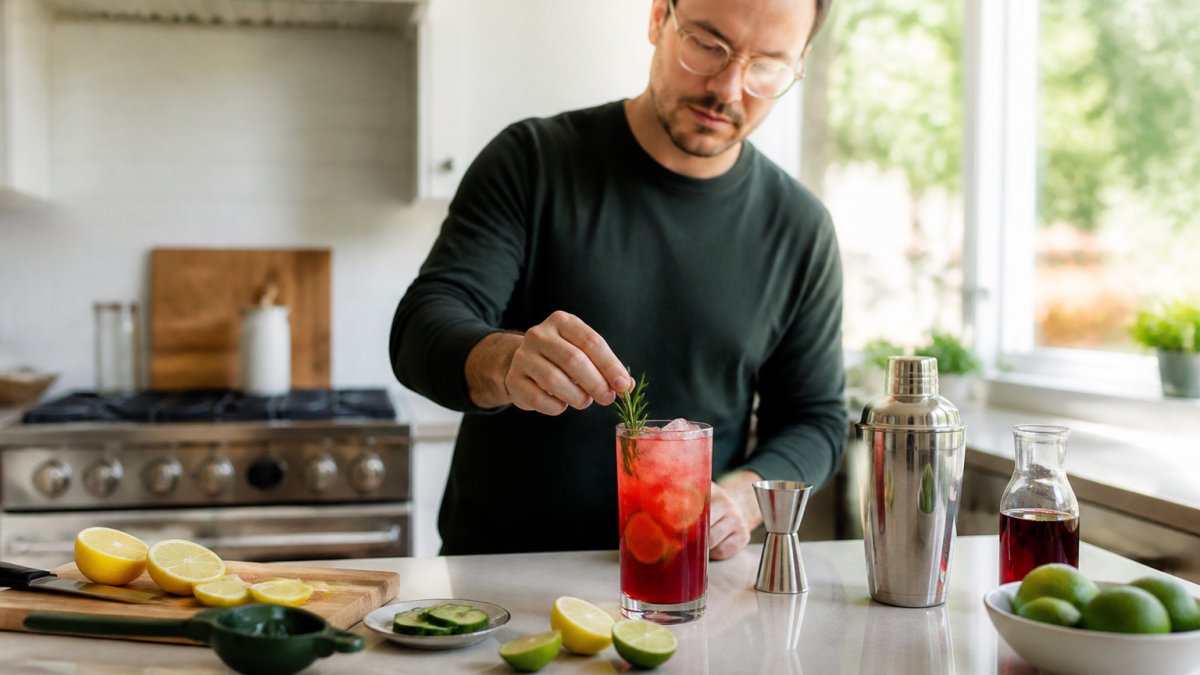
A month at home is one of the most practical ways to explore the idea. Plan your evenings in advance, stock your kitchen with appealing alternatives, and build a small routine around the ritual of making a drink.
Many people find that the ritual matters as much as the taste. For a set of drinks to make throughout the month, browse Non Alcoholic Craft Cocktail Recipes: 12 Zero-Proof Drinks.
Start Your Sober Curious Experiment With a Zero-Proof Box
If you are ready to test the idea, the simplest starting point is a box that supplies everything you need.
Our goal is to make the experiment easy: no liquor store run, no hunting for obscure ingredients, and no buying full-size bottles you will use once. CHOOSE MY BOX

Frequently Asked Questions
What does sober curious mean?
Sober curious describes a mindful, flexible approach to alcohol in which you examine your drinking habits and choose when, whether, and how much to drink based on your own goals. It is not a rule of total abstinence. Many people who identify as sober curious still drink occasionally, while others cut back or stop entirely for a period. The core idea is curiosity: asking how you feel with and without alcohol, and making intentional choices rather than drinking by default at social events or after work.
How is being sober curious different from sobriety?
Sobriety usually refers to abstaining from alcohol, often as part of recovery from alcohol use disorder. Being sober curious is a lighter, self-directed exploration that does not require abstinence or a diagnosis. Someone who is sober curious may take an alcohol break, reduce how often they drink, or simply pay closer attention to their habits. If you suspect your drinking is causing harm or feels out of control, speak with a doctor or addiction professional rather than relying on a self-guided experiment.
What can you drink instead of alcohol at social events?
Sober curious drinks often include sparkling water with fresh citrus, herbal teas served over ice, and zero-proof cocktails made with nonalcoholic spirits, shrubs, and house-made syrups. Choosing a drink with a garnish and a glass that matches what others are holding can make it easier to blend in. DEVIANT Cocktail Club's THE ALIBI | Zero-Proof box includes a full-size 0.0% ABV zero-proof spirit and three original recipes, each serving four, so you can prepare crafted nonalcoholic cocktails for guests.
Can you be sober curious and still drink occasionally?
Yes. Sober curiosity is not a pass-or-fail test, and it does not require giving up alcohol forever. Many people use it to decide when drinking genuinely adds value to an occasion and when it does not. You might skip alcohol on weeknights, drink less at celebrations, or choose nonalcoholic options at certain events. The goal is awareness and intention. If you find that stepping back is difficult or that you feel pulled to drink in ways you cannot control, that is a signal to seek professional support.
