

Table of Contents
- Why Non Alcoholic Craft Cocktail Recipes Beat Standard Mocktails
- How to Make Mocktails That Taste Like Real Cocktails
- Easy Mocktail Recipes for Home Bartenders
- Zero-Proof Cocktail Recipes That Copy the Classics
- Non-Alcoholic Drinks for Parties: Batching and Make-Ahead
- Ingredients, Substitutions, and Tools That Make It Easier
- Conclusion
- Frequently Asked Questions
Last Updated: October 14, 2026
Why Non Alcoholic Craft Cocktail Recipes Beat Standard Mocktails
A well-built zero-proof drink is a craft cocktail with the alcohol removed, not a sad glass of juice. Most mocktails fail because they treat the absence of spirits as the whole recipe, then cover the gap with sugar. Non alcoholic craft cocktail recipes build structure from bitters, syrups, tea, citrus, and texture so the drink stands on its own.
At DEVIANT Cocktail Club, we build zero-proof boxes around that same idea, with a full-size 0.0% ABV spirit, house-made syrups and premium bitters inside. A cocktail balances sweet, sour, bitter, and dilution; remove the spirit and you remove body and bite, so replace both deliberately.
The NIH guidance on standard drink sizes is a useful reference point here: a zero-proof pour contains no alcohol at all, which is exactly the point for designated drivers and anyone taking a night off.
How to Make Mocktails That Taste Like Real Cocktails
To make mocktails taste like real cocktails, replace what alcohol contributes rather than hiding its absence. Alcohol adds bitterness, heat, and weight; bitters, strong tea, and saline restore the first two, while syrup and juice restore the third.
Balance Sweet, Sour, and Bitter Without Alcohol
Start with a ratio, then adjust by taste. A reliable zero-proof sour is 2 parts juice or tea, 1 part citrus, and ¾ part syrup, plus 2 to 3 dashes of bitters.
Most home bartenders skip bitters assuming they contain alcohol. Many do, by a small amount, so check labels and look for alcohol-free versions. A pinch of salt does similar work when bitters are off the table.
Shake, Stir, and Serve: Technique That Changes the Drink
Technique does more for a zero-proof drink than any single ingredient. Shake anything with citrus, juice, or syrup: 10 to 12 seconds with ice chills and aerates it. Stir anything clear and spirit-forward so you do not cloud it.
- Shake: sours, fruit-forward drinks, anything with egg white or cream
- Stir: stirred classics, tea-based and spirit-forward builds
- Double strain: use a fine mesh strainer when you shake with herbs or muddled fruit
Easy Mocktail Recipes for Home Bartenders
Easy mocktail recipes for beginners follow the same three-part template: a base, a modifier, and a finish. Once you know it, you can build a drink from whatever is in the fridge.
The base is the largest volume and carries the drink's identity (juice, tea, or a zero-proof spirit). The modifier is the small, intense ingredient that creates contrast (citrus, syrup, bitters, saline).
Citrus and Herb Coolers
Basil-Grapefruit Cooler, Serves 1. Prep time: 5 minutes. Difficulty: Easy. Equipment: shaker, fine-mesh strainer, jigger, Collins glass.
Muddle 3 basil leaves with ¾ oz honey syrup in a shaker.
Why it works: grapefruit brings bitterness and acidity at once, while basil supplies the aromatic top note alcohol normally provides.
Tarragon-Lemon Spritz, Serves 1. Prep time: 5 minutes. Difficulty: Easy. Equipment: shaker, strainer, wine glass.
Fruit-Forward and Tea-Based Sips
Hibiscus-Cranberry Coupe, Serves 1. Prep time: 10 minutes (plus chilling). Difficulty: Easy. Equipment: shaker, strainer, coupe glass.
Steep 2 hibiscus tea bags in 8 oz hot water for 8 minutes, then chill completely.
Why it works: tea brings tannin, which reads as structure on the palate, the same drying sensation as red wine or an oak-aged spirit.
Peach-Black Tea Highball, Serves 1. Prep time: 5 minutes. Difficulty: Easy. Equipment: highball glass, bar spoon.
Testing Notes and Common Adjustments
These recipes were built around a 2:1:¾ ratio (base : citrus : syrup), then adjusted by taste:
- If the drink tastes sweet but flat, add ¼ oz citrus before adding more syrup.
- If the drink tastes sour but thin, add ¼ oz syrup and a pinch of salt.
- If the drink tastes watery after 5 minutes, your ice is too warm, use larger cubes or chill the glass first.
Zero-Proof Cocktail Recipes That Copy the Classics
Zero-proof cocktail recipes that copy the classics work when you match the original's texture, not just its flavor. Espresso, tomato, and milk all give a drink body that stands in for spirit.
Zero-Proof Espresso Martini and Milk Punch
For a zero-proof espresso martini, shake 2 oz fresh espresso, 1 oz oat milk, ¾ oz vanilla syrup, and a pinch of salt over ice. Strain into a chilled coupe.
Milk punch is even simpler. Combine 3 oz strong tea, 1 oz cream, ½ oz honey syrup, and a dash of vanilla. Shake, then strain. The dairy rounds off the edges the way barrel aging would.
Zero-Proof Bloody Mary and Spirit Alternatives
A zero-proof Bloody Mary is one of the easiest classics to nail because tomato juice already carries body and umami.
For a spirit alternative, look for a full-size non-alcoholic spirit rather than a flavored syrup. THE ALIBI | Zero-Proof includes one in every box, and it does the job a base spirit would: it carries the drink instead of disappearing into it.

Non-Alcoholic Drinks for Parties: Batching and Make-Ahead
Non-alcoholic drinks for parties are easiest to serve when you batch them ahead of time. Build one large-format version in a pitcher and let guests pour their own.
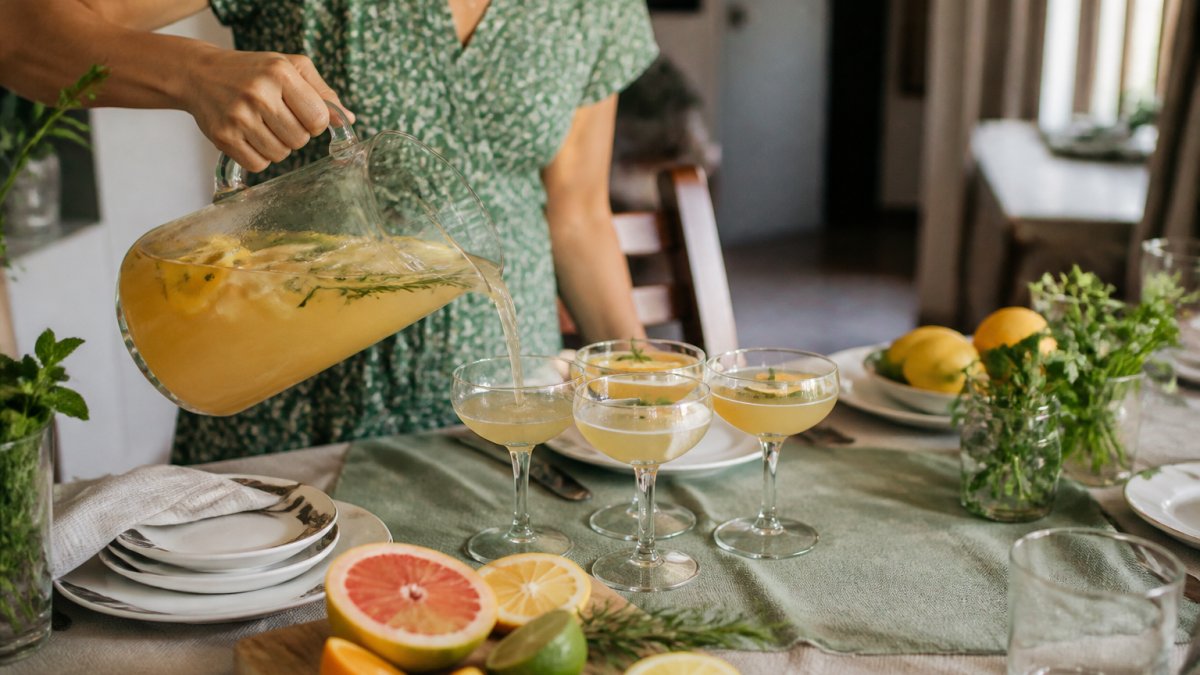
Multiply your recipe by the number of guests, but hold the soda and ice until serving, carbonation dies in a pitcher and ice dilutes a batch fast. Keep the base chilled and top each glass individually.
- Batch the base up to 24 hours ahead and refrigerate
- Add citrus fresh if you can, since it fades overnight
- Set out garnishes in small bowls so guests finish their own drinks
Ingredients, Substitutions, and Tools That Make It Easier
The right tools and a few smart swaps remove most of the friction from zero-proof bartending. You do not need a full bar setup, just a clear understanding of what each ingredient does, so you can swap intelligently instead of guessing.
What Each Ingredient Actually Does
| Problem | Fix | Why It Works |
|---|---|---|
| Drink tastes flat | Add 2-3 dashes alcohol-free bitters | Bitters restore bitter structure and aroma, which read as "adult" on the palate |
| Too sweet | Cut syrup by half, add ¼ oz citrus | Acid cuts perceived sweetness without diluting the drink |
| No body | Swap water for strong tea | Tannin adds weight and a drying finish that mimics spirit |
| Dairy-free needed | Use oat or coconut milk | Oat milk has a similar fat and protein profile to cream; coconut milk is richer |
| No shaker | Stir in a mason jar with ice | Chills and dilutes evenly; 20 seconds of stirring equals 10 seconds of shaking |
| Drink goes flat fast | Chill the glass and the soda separately | Cold liquid holds carbonation longer |
| Herbs taste muddy | Double-strain after shaking | Removes shredded leaf matter that turns bitter |
Batching Quantities for a Party
Most recipes scale linearly, but carbonation and ice do not:
- Base and modifiers: multiply by the number of servings. A 10-serving batch of the Hibiscus-Cranberry Coupe is 30 oz tea, 10 oz cranberry, 5 oz lime, 5 oz syrup.
- Soda and sparkling water: add per glass, never to the batch. A 2-liter bottle of club soda yields about 22 four-ounce pours.
- Ice: plan on 1 to 1.5 cups of ice per guest for shaking and serving combined.
Dietary Swaps
- Honey syrup → agave or maple: swap one for one. Agave is slightly sweeter, so reduce by 10 percent if you are sensitive to sweetness.
- Simple syrup → monk fruit or allulose syrup: swap one for one for a lower-sugar drink. Note that these sweeteners do not caramelize or add the same mouthfeel, so the drink will taste slightly thinner.
- Oat milk → coconut milk: swap one for one, but expect a richer, more tropical flavor. Coconut milk also separates in the fridge; shake before using.
Alcohol-Content Expectations
This matters if you are serving someone who is pregnant, in recovery, or on medication that interacts with alcohol.
- A drink made from juice, tea, syrup, and soda contains no alcohol. That is the baseline.
- Bitters are the wild card. Most aromatic bitters are around 40% ABV by volume, but you use dashes, not ounces. A standard dash is roughly 1/8 teaspoon, so 3 dashes in a drink contribute a very small amount of alcohol, often less than 0.5% ABV in the finished drink, though this varies by product and pour. If you need a drink to be strictly 0.0% ABV, choose alcohol-free bitters or skip them and use a pinch of salt instead.
- Some fermented mixers contain trace alcohol. Kombucha, some shrubs, and certain vinegars can carry small amounts. Check labels if strict 0.0% matters.
Tools Worth Owning
A 17 oz shaker handles a single drink comfortably. The Claro Clear Crystal Cocktail Shaker is $27.00 and holds exactly that, with a polished stainless-steel lid. The Claro Pink Cocktail Shaker & Martini Set is $39.50 and includes two matching martini glasses. Beyond the shaker, a fine-mesh strainer, a jigger, and a bar spoon cover 90 percent of what these recipes ask for.
Conclusion
Building a drink that holds up without alcohol takes more thought than most hosts expect, and the difference shows up the moment someone takes a sip. DEVIANT Cocktail Club takes the sourcing problem off your plate: every box ships free with a full-size zero-proof spirit, house-made syrups, premium bitters and garnishes, plus step-by-step recipe cards and guided video tutorials. You can skip, pause, cancel, or gift your box anytime.
Frequently Asked Questions
How do you make a non-alcoholic cocktail taste complex?
Complexity comes from layering three or four flavor directions instead of one. Start with a base such as a zero-proof spirit, tea, or kombucha, then add a sweet element like honey syrup or fruit juice, a sour note from lemon or lime, and a bitter or botanical finish from bitters, ginger beer, or fresh herbs. A pinch of salt and a proper garnish sharpen the whole drink. The box from DEVIANT Cocktail Club includes the zero-proof spirit, house-made syrups, and bitters so you are not chasing single bottles.
What can you use instead of alcohol in a craft cocktail?
Zero-proof spirits built to mimic gin, rum, or whiskey are the closest swap, and they are already inside THE ALIBI | Zero-Proof box. Other solid stand-ins include strong brewed tea, espresso, kombucha, ginger beer, club soda, and fruit shrubs. Each brings body or bite that plain juice cannot. Match the substitute to the original cocktail: tea for whiskey drinks, citrus and soda for gin drinks, and coffee for espresso martinis.
How do you make a zero-proof drink look like a real cocktail?
Glassware and garnish do most of the work. Serve in a chilled coupe, highball, or martini glass, then add a citrus twist, a herb sprig, or a dehydrated fruit wheel. A thin layer of foam from shaken aquafaba or cream mimics the top of a sour or espresso martini. Clear ice and a clean rim finish the look. Guests judge the first impression before the first sip, so treat presentation as part of the recipe.
Can I batch non-alcoholic drinks for a party ahead of time?
Yes, and batching is the easiest way to serve a crowd. Mix the base, syrups, and juices in a pitcher up to 24 hours ahead and refrigerate. Add carbonated elements such as club soda, seltzer, or ginger beer right before serving so the fizz survives. Hold back garnishes until the last minute. One DEVIANT Cocktail Club box makes 12 craft cocktails across 3 recipes, which covers a small gathering without a liquor store run.